
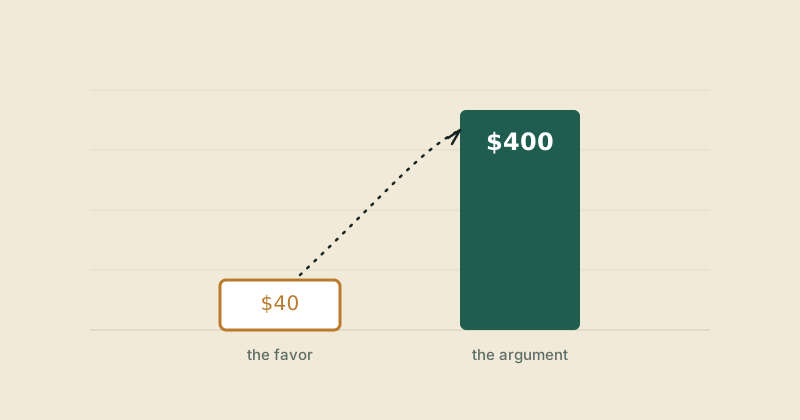
You're halfway through a bathroom remodel. The customer walks by and says, "Hey, while you're at it, can we swap out that vanity too?" You say sure, figure you'll sort out the price later, and keep working.
That "we'll figure it out later" moment is where a lot of contractors quietly lose money.
What a change order actually is
In the industry, this is called a change order: any change to the original job after the work has already started. It sounds small. In practice, it's one of the most common ways a profitable job turns into a headache.
What the numbers actually say
The American Institute of Architects tracks how often change orders happen on real projects. Even small jobs average close to two change orders each. Bigger projects can see ten or more.
A joint study by PlanGrid and FMI, two well known names in construction research, surveyed almost 600 construction professionals and found something bigger. Poor communication and missing information cost the U.S. construction industry over $31 billion a year in wasted rework. More than a quarter of that waste traces back to one thing: people not communicating clearly about what changed.
Sound familiar? That's the exact moment we're talking about. A customer asks for something different, nobody writes it down properly, and someone ends up paying for the confusion later. Usually the contractor.
The honest gap
Most of this research looks at construction broadly, big commercial jobs with full project management teams, not a two person remodeling crew working out of a truck. Nobody has published a formal study measuring this exact problem for small residential contractors. We looked.
But we didn't need a study to notice the pattern. We watched it happen, over and over, talking to contractors doing exactly this kind of work. A customer asks for a small change. It gets agreed to with a nod or a text. Nobody prices it properly in the moment. Weeks later it shows up on the invoice, and now it's a conversation nobody wants to have.
Why it's actually worse for small contractors
If anything, this hits small residential contractors harder than it hits big commercial jobs, not less. A large commercial project usually has a project manager whose entire job is tracking changes on paper. A small remodeling contractor doesn't have that person. They have a phone, a truck, and a job to finish. There's nobody else to catch the change that never got written down.
What actually helps
Write it down. Every change, even the ones that feel too small to bother with. If it changes what you're doing, it changes what it costs.
Price it before you do the work, not after. Once the work is done, you've lost your leverage to have that conversation.
Send something in writing. A text confirming the price works. A formal message works better. What doesn't work is a verbal "yeah, sure, that's fine."